Tuesday, November 15, 2005

The Chinese Optometrist


At one or the other unexpected event during one or the other unexpected stay, I somehow lost my glasses -so after explaining what I could to the harbor authorities (it wasn’t much of an explanation) I had to visit the Chinese Optometrist. The waiting room was one of the most peaceful and harmonious places I have ever been, nothing fancy, just a very quiet garden framed with the traditional red gate and Koi pond, reminiscent of the Slow Pavilions, with an excellent selection of cranes and magazines.

I fill out the appropriate forms, exchange pleasantries with the receptionist and put my name on the list. Soon, at the appropriately auspicious hour, to a strike of the gong, the Optometrist himself appears and makes a decorous bow. “Shur-Shur-Shurr” he says. This as good a time as any to mention that I do not speak Chinese. Also without my glasses, I cannot see. In fact, it is only by a series of highly logical, yet fallible inferences, that I have concluded I am at an optometrists at all.

Nonetheless, I like his face. He reminds me of my father. I find my father inscrutable, remote and ruthless (in a word, “asiatic”, “oriental”). He was a doctor, too. It must be the white coat. He gestures sociably. I want to make him happy, to please him. To cooperate.

It’s just like a visit to an American optometrist -only instead of an eye exam where you read the eye chart aloud and the optometrist rotates different lenses in and out of the phoroptor and you answer whether you can see “better” or “worse”, at the Chinese optometrist all wrong, incorrect or hesitant answers are requited with a sharp rebuke from a supple stick kept within easy reach in the little office. It doesn’t seem like such a bad stick -it has a pleasing finish and seems actually quite delicate in the optometrist’s strong surprisingly rough hands (toughened and coarse, as though the good doctor, an older gentlemen, had done hard labor early in life), but personified with an elastic quality that made it quite piquant. The blows are not administered maliciously, but seriously and regularly.

You might think that this places an undue pressure on the patient to perform or try to guess the right answer or otherwise cheat to avoid punishment, but from the Chinese perspective there are billions of Chinese, and almost all of them myopic and therefore simply no time to waste on a few malingerers who would otherwise clog the process. Almost everyone cheats. Charts and cheat sheets are easily bought and sold in the marketplace for memorization the night before. The receptionist will sell you one. These cheat sheets are also in Chinese. They are no use to me, even though I bought a laminated “For Dummies”-styled one. I do understand that Chinese is a tonal language, though, so I try to answer each stinging interjection of the stick with a different pitch. I am an instrument. I am being tuned. I have faith in the process even though it is painful. I have faith in the process, perhaps because it is painful. I believe that the tears that spill from behind the mask of the phoroptor are tears of growth, painful growth, because I am being taught a new language, because I am at last being made to see.

Wednesday, November 09, 2005

Nightlife in The Forbidden City


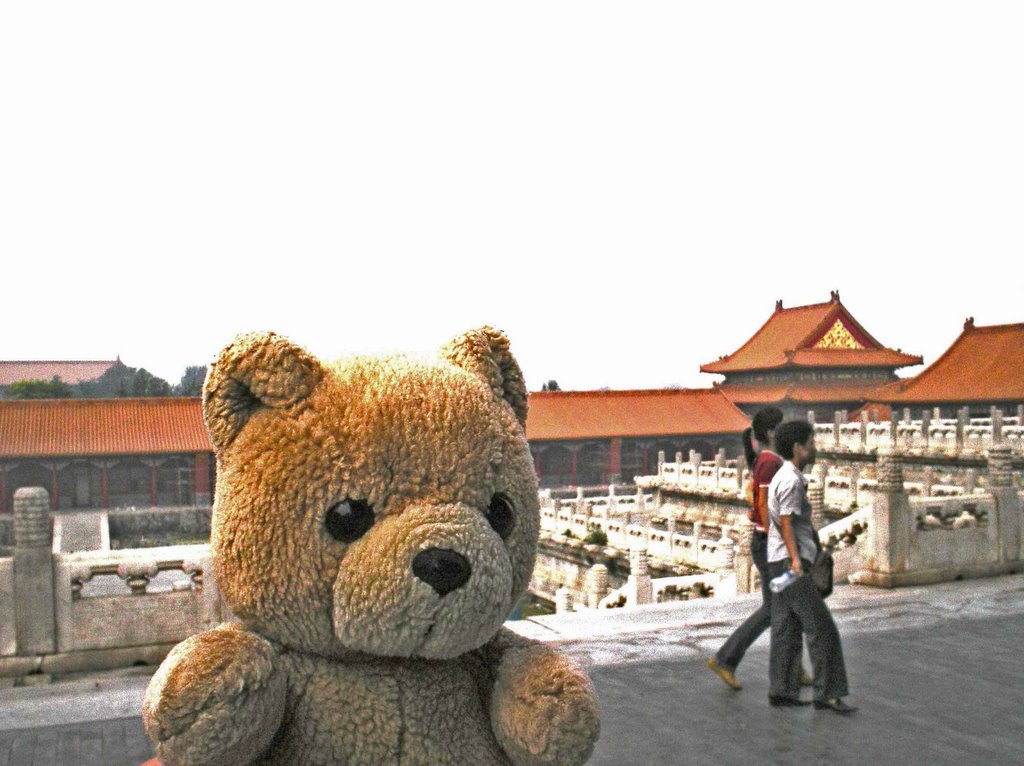
The number of rooms is given at 9999. But this is a mistranslation, or a euphemism. The number is, in fact, infinite. The Emperors never died. The Dynasties never vanished. They never even moved away, but still persist, in some farther courtyard, some older wing. All of China’s history recurs, eternally, simultaneously in the infinite space of the Forbidden City. From the perspective of the window farthest to the east, the Great Wall is still being constructed. From the farthest west, it has already crumbled, as have the pyramids and the last of the new glaciers. From the farthest south, the Great Wall has not yet even been conceived of. From the north, it cannot even be concieved.

For this reason, the wisest of Emperors have always kept birds and creatues with finest senses, who can catch the most distant scent of gunpowder or trechery, burning silk, from chambers yet to be inhabited. It is in this sense it is completely accurate to say that the Forbidden City is haunted: but haunted only by the present.

The business of the the great Celestial City is the same as in the heavens in whose pattern it is cast: a series of messages sent across its infinite expanse, from one gallery to another. But the messages take so long to travel that they are invariably misunderstood, beyond all hearing, their authors long vanished, their addressees faded into the palimsest of the Middle Kingdom itself.

The gift shop is also infinite and features and amusing puzzle that allows you to build a scale replica of the Forbbidden City at home. The replica is also infinite and consists of an infinite series of identical unique pieces that are each used only once and can occupy only one and only one place in the structure. Each piece is effectively a hologram containing all the information present in all the other pieces. As the model is itself infinite, the souvenir has an added shelter value as it is possible to live in it. It is also quite possible to get lost.

So when touring the Forbidden City, if you get seperated from your tour group and know the short cuts -if you can walk a little farther and faster than the rest -quite a bit faster, but only a little faster than your own relection, you may yet overtake Marco Polo, himself awaiting his first exaggeration. If you run, you can escape the time of the Mongols entirely, though you should slow down and catch your breath before you run through the pearl curtain, for great and subltle events are attended by the First Emperors: here, the first presentation of the novelty of tea. To entirely unjaded ears the first notes of music. To unreading eyes, the first brushstrokes of writing.

But the true function of the Forbidden City is its nightlife; this is the only time the palace appears to everyone as it actually is, infinite. For just as the palace was constructed on the patterns eternally sketched in the constellations above, so too, was it built for the same purpose: as the setting for desire, forgetting.

My Game with Lo Pan


The SS Blessed Pensioner, having made an unscheduled detour into Drinking Horse Gorge, is compelled to make a further unscheduled stop


-Lo Pan, most wise and most generous, when will the people be free?

-Freedom is not possible as long as belief in individuals or collectivities exist.

-No, I mean the hostages, when will you let them go?

-If neither individuals, nor collectivities exist who can I be said to be holding? If freedom is not an impossibility, and there is no reason it should not exist, how can things be other than free?

-I mean the hostages from the boat. Is it your plan to eventually let them go?

-Chance and design are simply words we use to describe the same thing depending on how we are feeling. So it makes no difference whether I make the wisest choice, the kindest choice, the most appropriate choice, or if we were to throw dice for the souls on the boat, like in Coleridge’s “Rime of the Ancient Mariner”.

-These dice are labeled in Chinese.

-Yes, I know. Oh, look: today you are not lucky.


And a thousand slimy things
Lived on;and so did I

Tuesday, November 01, 2005

The Captain's Table


meanwhile, back on the Yangze, aboard the SS Blessed Pensioner

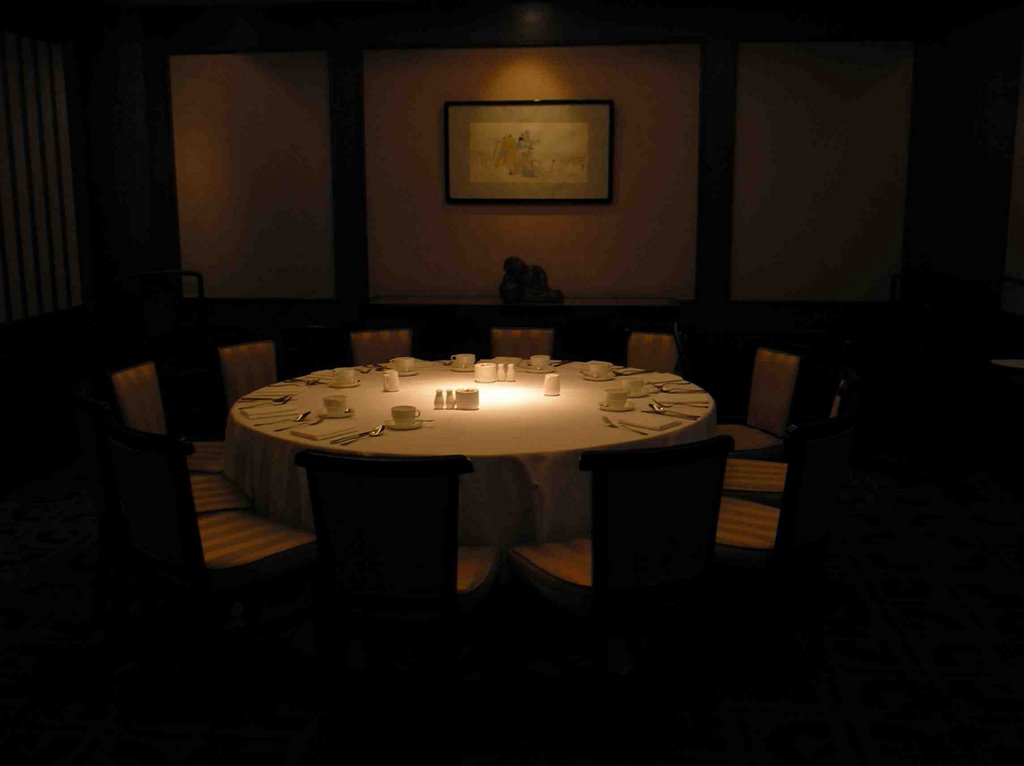
I am at the Captain’s table.

“I invited you here” said Captain Shan, “because you are the only passenger with a dinner jacket. The fact that no one dresses for dinner is proof positive that Americans have no civilization and, worse, have been able to get along fine without one. Civilization is a thing of the past.”
“Yet” said the Captain settling down, “I have utter contempt for you. You seem like a fellow who has never finished anything.”

I could see that the Captain and I were going to get along fine.

The rest of the meal passed amicably. The Captain’s remarks to me were unheard, or simply did not admit of a conversational follow-up. Some of the other guests included some of the few younger or more attractive passengers of the boat, which was a great blessing for me, though young and really pretty people generally don’t have much conversational skill. The remainder seem to have been chosen at random and passed the fish course talking about giving their dog shots. The Captain remained silent for the rest of the meal, the dishes passing silently, unremarked and untouched before him, like offerings to an idol in dress whites, a part that suited him well, as an obviously seasoned and older man of the sea, the crooked angle of his head unmoving, his thoughtful Ahab-like glare, focused at infinity at the edge of a wine glass. Somewhere around the sesame-seaweed tiramisu, the Captain began speaking again, in a quiet uninflected way, and I, as his immediate companion and being more in the neighborhood of the direction of the crook of his neck, took the posture of his interlocutor.

“You must pilot the Yangtze for fourteen years before they will allow you a Captaincy. The Three Gorges were historically an impassible and treacherous stretch, full of whirlpools and cataracts. The Three Gorges Dam...”

And here the other diners perked up, because we had all been to the Three Gorges Dam site.

“The Three Gorges Dam will change things even further. It will drown this whole area to the depth of over 100 meters. Everything. The Three Gorges. The Shibaozhai Temple. Fengdu, the Ghost City. 1.3 million people to be relocated.”

Someone commented on the power generation of the future dam and compared it to the TVA. Shan did not appear to hear them. It was time for coffee and liqueurs anyway.

This is the one field where I actually have knowledge: I was going to propound some suggestions to my more lithesome companions, but they had some twentysomething thing to do like go smoke. I thought about going with them. Maybe I sighed. The Captain spoke again:

“Men will sometimes say to another man: ‘She’s not all that attractive.’ Sometimes this is true, other times it is just to keep the sheer terror of the thing at bay, like when we say ‘it’s not so bad’ or ‘death will release me.’”
I keep hoping that Shan is drunk, but he has not touched his goblet. By now there’s a little collection of white moisture collecting in the corner of his mouth.
“The sad and horrible thing that you eventually realize as a man is that all of your human feelings are in your balls. Chinese Medicine teaches us this.”
Shan reaches for his tea cup. He picks it up. He holds it. Then nothing seems to happen for what in tea drinking terms is a long, long time. The sequence seems to have somehow failed or been forgotten. It goes on long enough for me to seriously consider joining him, out of courtesy, in some sort of weird frozen toast.

But Shan relents and puts down his cup, somewhat naturally.

“Our deepest sadness -our loneliness, comes right from the muscles of the sac. And our compassionate moments.”
The Captain rearranged himself. I stole a glance at his dress whites. It was hard to tell if it was just a fold of the napkin, but for an older gentleman the Captain seemed to have an enormous erection.
“Our compassionate moments are when a cool breeze is blowing on them. It seems improper for an old man to leer.”
“But that’s when a man really knows he’s done for, that he’s going to die and not come back. When he’s somewhere and there are all these young women.”
Shan paused. I was immobilized.
“And he realizes” Shan continued, “that he will never equal his imagination. That he will never know or catch up with his possible desires. This is -how to put it -totality.”


“Tomorrow’s drink of the day,” said Captain Shan “is Daiquiris.”

Captain Shan did not seem like the sort of man who drank Daquiris.

“Tomorrow,” said Captain Shan “I think I will pilot the boat into Drinking Horse Gorge, to demonstrate my understanding of totality. And compassion.”

Why do such men always find in me a confidante?

“Not all will die,” added Shan “some will survive, despite many injuries.”

“I find the idea of all these countless Daiquiris spilling into the muddy yellow Yangtze appealing.”